


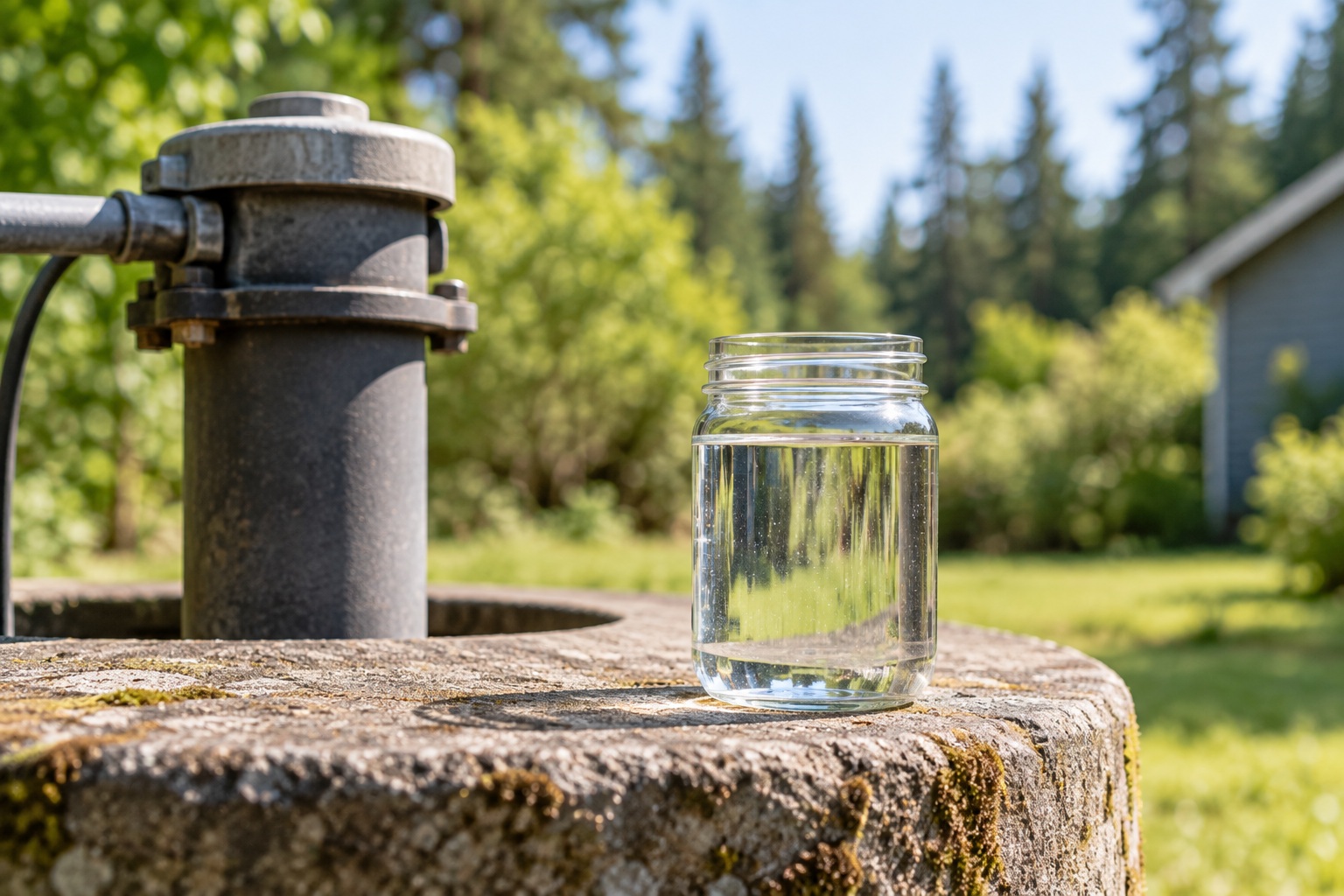
Arsenic in well water can pose a long-term health risk even when the water looks, tastes, and smells completely normal. Naturally occurring arsenic can enter groundwater in Washington and Oregon as water interacts with certain rock and soil formations. The EPA’s drinking water limit for regulated public water systems is 10 parts per billion (ppb), but private well owners generally need to test their own water. If arsenic is detected, certified treatment technologies such as reverse osmosis or specialized adsorption filtration may help reduce exposure.
Arsenic in well water is one of the more difficult water quality problems for homeowners to recognize. Unlike sulfur, which can produce a rotten egg smell, or iron, which may leave reddish stains, arsenic typically provides no noticeable warning signs.
That means a glass of crystal-clear well water can still contain elevated arsenic levels.
For homeowners throughout Washington and Oregon, understanding where arsenic comes from, how it affects health, and when to test is an important part of maintaining a private well.
The good news is that arsenic can be detected through laboratory testing, and appropriate treatment technologies can reduce its concentration in drinking water. The key is choosing a solution based on actual test results rather than appearance or assumptions.
Quick Facts About Arsenic in Well Water
Why Is Arsenic Found in Pacific Northwest Well Water?
Arsenic occurs naturally in the Earth’s crust. As groundwater moves through certain rocks and soils, it can dissolve arsenic-containing minerals and carry arsenic into underground aquifers.
This process can occur without any industrial pollution or obvious environmental damage.
Washington and Oregon both have groundwater sources where naturally occurring arsenic has been identified. However, arsenic concentrations can vary significantly between aquifers and individual wells.
Several factors influence arsenic levels, including:
- The geology surrounding the groundwater source
- The minerals present in underground rock and soil
- Groundwater chemistry, including pH and oxidation conditions
- The depth and location of the well
- Seasonal or long-term changes in groundwater conditions
Human activities, including historical mining and industrial operations, can also contribute arsenic to the environment in some locations.
Importantly, living near a well with elevated arsenic does not automatically mean your own water contains the same concentration. Even neighboring wells can draw from different groundwater conditions.
What Is the Safe Arsenic Level in Drinking Water?
The U.S. Environmental Protection Agency has established a maximum contaminant level of 10 parts per billion (ppb) for arsenic in regulated public drinking water systems.
This is equivalent to 10 micrograms per liter (µg/L) or 0.010 milligrams per liter (mg/L).
The federal limit is a regulatory standard for public water systems, not a guarantee that every concentration below it is completely risk-free. Health risks associated with arsenic generally increase with greater exposure over time.
Private residential wells are generally not regulated under the federal public drinking water rules. That makes testing and treatment decisions especially important for well owners.
Understanding Your Arsenic Test Results
| Arsenic Level | What It Means |
|---|---|
| Not detected | Arsenic was below the laboratory’s reporting limit. Continue appropriate routine testing. |
| Detected below 10 ppb | Below the federal public drinking water limit, although reducing long-term exposure further may still be beneficial. |
| 10 ppb or higher | At or above the federal limit. Confirm results as advised and use an alternative drinking water source while evaluating treatment. |
| Above 50 ppb | A substantially elevated result. Washington health guidance recommends immediately stopping use for drinking and food preparation. |
If your results are close to or above 10 ppb, contact your local health department or a qualified drinking water professional for guidance. Oregon also recommends follow-up testing when an initial result exceeds 8 ppb.
What Are the Health Risks of Arsenic in Drinking Water?
Long-term exposure to inorganic arsenic in drinking water is associated with an increased risk of certain cancers and other chronic health problems.
Health effects depend on factors such as the concentration of arsenic, how long someone is exposed, and the amount of contaminated water consumed.
Potential health concerns include:
- Increased risk of skin, bladder, and lung cancers
- Skin changes, including thickening or discoloration
- Effects on the cardiovascular system
- Neurological and other systemic health effects
- Potential developmental concerns associated with exposure during pregnancy and childhood
These effects generally relate to exposure over time, which is why arsenic testing matters even when nobody in the household feels sick.
Symptoms alone cannot determine whether arsenic is present or whether exposure has occurred. If you have concerns about arsenic-related health effects, speak with a healthcare professional.
How Do You Test Well Water for Arsenic?
The most reliable way to identify arsenic in well water is to submit a properly collected sample to a laboratory accredited or certified to analyze drinking water for arsenic.
Testing typically involves:
- Choosing a qualified laboratory: Confirm that the laboratory is approved to perform arsenic analysis in drinking water.
- Collecting a water sample: Follow the laboratory’s instructions for sample containers, collection, and handling.
- Reviewing the results: Compare the reported concentration with applicable public health guidance.
- Arranging follow-up testing: Repeat testing when recommended, especially if results are elevated or conditions may vary seasonally.
- Evaluating treatment: If arsenic reduction is needed, choose equipment based on the test results and water chemistry.
United Water Services provides information about well water testing in the Vancouver, WA area. Homeowners should specifically request laboratory arsenic analysis, since not every basic water test includes heavy metals or other trace contaminants.
How Often Should You Test Your Well for Arsenic?
Testing frequency depends on your location, previous results, and state or local recommendations.
Washington’s Department of Health recommends that private well owners test for arsenic at least twice during ownership, including samples in different seasons. Oregon’s Health Authority recommends arsenic testing every three to five years, with more frequent testing when circumstances warrant.
Additional testing may be appropriate if:
- Your well has previously shown elevated arsenic
- You have never tested the well for arsenic
- You are purchasing a property with a private well
- Your groundwater conditions or water source have changed
- You have installed or serviced an arsenic treatment system
- Your local health department identifies a groundwater concern
Oregon also requires arsenic, nitrate, and coliform testing in certain real estate transactions involving domestic wells.
What Is the Best Arsenic Removal System for Well Water?
The best arsenic removal system depends on the concentration and chemical form of arsenic, along with other characteristics of the water.
Arsenic commonly occurs in groundwater in two inorganic forms: arsenite, often called arsenic III, and arsenate, or arsenic V.
These forms can behave differently during treatment. Some systems remove arsenic V more effectively, while arsenic III may require oxidation or another pretreatment step.
That means a system should not be selected based on a generic claim that it removes arsenic.
Reverse Osmosis
Reverse osmosis (RO) uses a semipermeable membrane to reduce dissolved contaminants, including certain forms of arsenic.
Under-sink reverse osmosis systems are commonly considered when homeowners want to treat drinking and cooking water at a specific faucet.
However, effectiveness depends on the system’s certification, arsenic chemistry, operating conditions, and maintenance. Some RO systems may require pretreatment to address arsenic III effectively.
Adsorption Filtration
Specialized adsorption media, including certain iron-based materials, can bind arsenic and reduce its concentration as water passes through the treatment system.
These systems may be designed for a single drinking water outlet or broader household treatment, depending on the application.
Water chemistry, including pH and competing substances such as phosphate or silica, can influence performance and media life.
Oxidation and Filtration
In some applications, converting arsenic III into arsenic V can improve the effectiveness of subsequent treatment.
Oxidation may be paired with filtration or adsorption technology as part of a larger treatment process.
Because treatment chemistry can be complex, this approach should be designed around laboratory results and professional evaluation.
What Certifications Should an Arsenic Water Treatment System Have?
Look for independent certification that specifically covers arsenic reduction rather than relying only on broad claims about filtration.
Depending on the equipment type, relevant certifications may include:
- NSF/ANSI 58: Applies to reverse osmosis drinking water treatment systems, with specific contaminant reduction claims available for qualifying products.
- NSF/ANSI 53: Covers certain drinking water treatment systems with health-related contaminant reduction claims, including arsenic claims where applicable.
Not every product certified under these standards is certified to reduce arsenic. Check the individual model’s certification listing, the arsenic species covered, and any conditions or limitations of the claim.
Water quality professionals should also consider system capacity, replacement schedules, testing requirements, and how treated water will be monitored.
Should You Treat Arsenic at One Faucet or Throughout the Home?
Arsenic treatment can be installed at the point of use, such as a kitchen sink, or at the point of entry, where water enters the home.
Point-of-use treatment is often practical when the main concern is water consumed through drinking and food preparation.
Whole-house treatment may be considered when broader treatment is warranted, but it can require a different level of equipment, monitoring, and maintenance.
For most households, the primary exposure concern is swallowing contaminated water rather than bathing in it. The right treatment scope should still be determined using the measured arsenic level and guidance from qualified professionals.
United Water Services offers whole-house water filtration information for homeowners comparing water treatment approaches.
Will a Water Softener Remove Arsenic?
A standard water softener is not a reliable substitute for a treatment system specifically designed and certified to reduce arsenic.
Water softeners primarily address hardness minerals such as calcium and magnesium. Although specialized ion-exchange technologies may be used in certain arsenic treatment applications, ordinary residential softeners should not be assumed to provide this protection.
The same caution applies to standard sediment filters, ordinary carbon filters, and UV disinfection systems. These technologies serve different purposes and should not be relied upon for arsenic reduction unless the specific equipment has an applicable verified performance claim.
Homeowners dealing with several water quality concerns may need a coordinated treatment approach that addresses hardness, iron, sediment, and arsenic separately.
Arsenic Water Treatment in Oregon and Southwest Washington
For private well owners in Vancouver, Camas, Washougal, Battle Ground, Ridgefield, and nearby Southwest Washington communities, groundwater testing is an important part of responsible well ownership.
The same applies to Oregon homeowners who rely on private wells, including properties in the Portland metropolitan area and surrounding communities.
Regional geology can create the conditions for naturally occurring arsenic, but the concentration in an individual well cannot be determined from its location alone.
For homeowners researching arsenic water treatment in Oregon or Washington, the most practical starting point is a laboratory test followed by an evaluation of treatment technologies suited to the results.
United Water Services helps homeowners explore water treatment solutions in the Vancouver area. Any arsenic-specific treatment recommendation should be based on confirmed testing, water chemistry, and the selected system’s certified capabilities.
Arsenic in Well Water FAQs
Can you taste or smell arsenic in well water?
What is the EPA limit for arsenic in drinking water?
Is arsenic common in Oregon and Washington well water?
Does boiling well water remove arsenic?
Does reverse osmosis remove arsenic from well water?
How often should I test my well water for arsenic?
How do I know if my arsenic removal system is working?
Protect Your Drinking Water With the Right Information
Arsenic in well water is easy to overlook because it rarely announces itself through an unpleasant smell, strange taste, or visible discoloration.
For private well owners in Washington and Oregon, testing is the first step toward understanding whether arsenic is present and whether treatment is needed.
If a laboratory detects elevated arsenic, certified treatment technologies may help reduce exposure. Choosing the right system depends on the arsenic concentration, water chemistry, and how the household uses its water.
Test your well for arsenic today. Contact United Water Services to discuss arsenic testing and appropriate treatment options for your home.


